Somatic Therapy vs. Somatic Coaching: What’s the Difference?

What they have in common
As the somatic coaching industry takes off and the psychotherapy world starts to embrace somatic techniques and nervous system-informed approaches more than ever before, it can be hard to tell the difference between the two.
Both use the body as a source of information and wisdom, track sensation, and support nervous system regulation.
Many of the approaches or modalities used can also overlap, such as Somatic Experiencing, mindfulness-based tools, nervous system education, and body awareness practices. They can address similar topics, such as personal development, improving boundaries and relationships, and developing emotional resilience. This is what makes it so difficult to tell the difference between somatic therapy and somatic coaching.
As someone who has experience offering both, let me break it down for you.
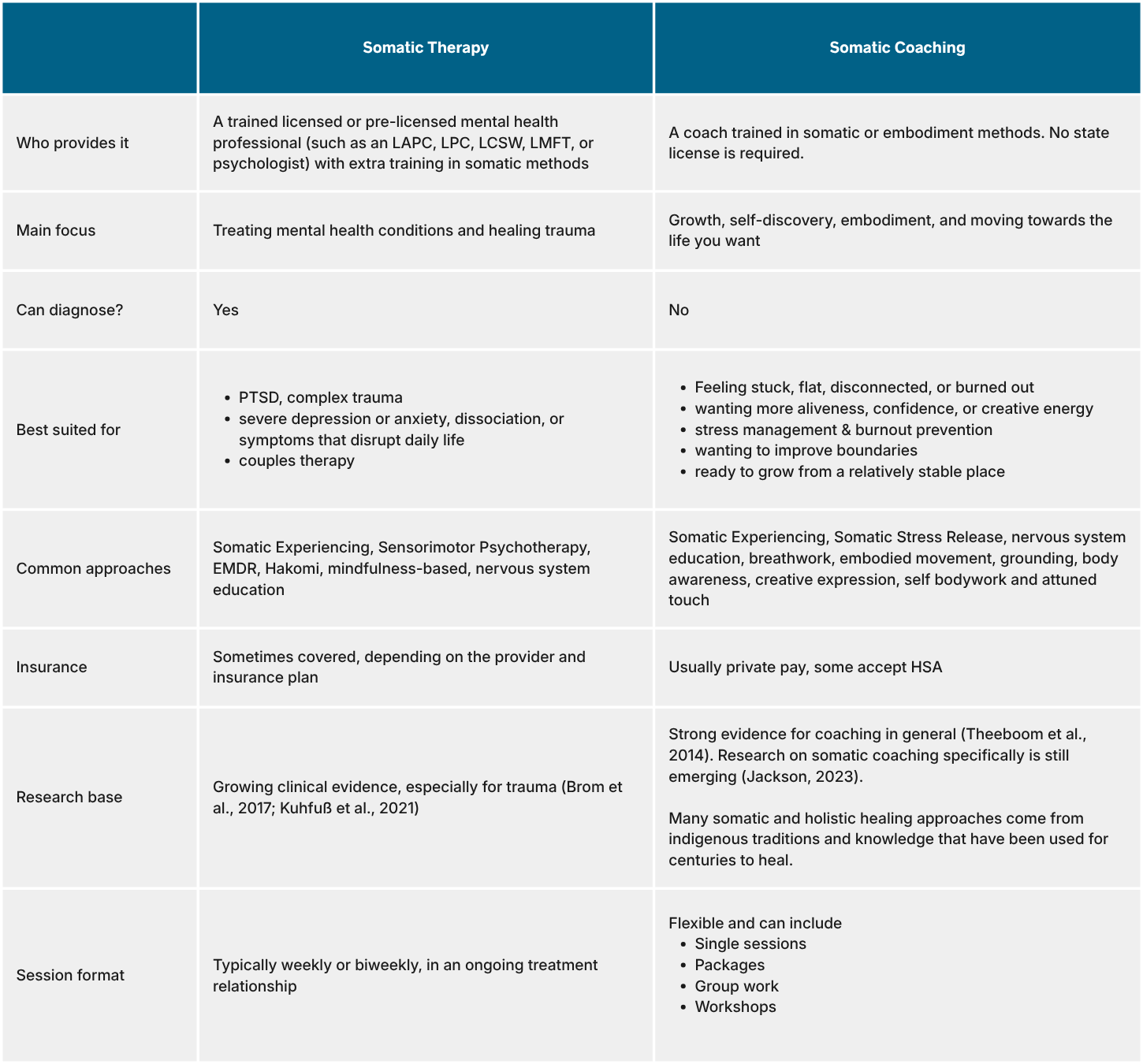
Somatic Therapy vs. Somatic Coaching
How to Decide Which One is Best for You

You might ask yourself this question: What are my goals for myself right now?
Is it to manage panic attacks or heal depression? Then a somatic therapist might be the right fit for you.
Is it to improve your confidence before you step on stage for a speaking engagement or feel comfortable in your body? Then you’d be looking for a somatic coach.
If you’re dealing with trauma symptoms, thoughts of self-harm, or anything that makes daily life hard to manage, a licensed somatic therapist is the right fit.
Somatic coaching can be a wonderful complement to therapy, especially if you don’t have access to a therapist who is trained in somatics, or can be a next step after it.
If you’re interested in somatic therapy, you can work with me at Rooted Healing Sanctuary Sex & Relationship Therapy Center, where I offer psychotherapeutic services specializing in couples, conscious intimacy, anxiety, and depression.
If you’re interested in somatic coaching, you can book a free consultation session below.
References:
Brom, D., Stokar, Y., Lawi, C., Nuriel-Porat, V., Ziv, Y., Lerner, K., & Ross, G. (2017). Somatic Experiencing for posttraumatic stress disorder: A randomized controlled outcome study. Journal of Traumatic Stress, 30(3), 304–312. https://doi.org/10.1002/jts.22189
Kuhfuß, M., Maldei, T., Hetmanek, A., & Baumann, N. (2021). Somatic experiencing: Effectiveness and key factors of a body-oriented trauma therapy: A scoping literature review. European Journal of Psychotraumatology, 12(1), 1929023. https://doi.org/10.1080/20008198.2021.1929023
Theeboom, T., Beersma, B., & van Vianen, A. E. M. (2014). Does coaching work? A meta-analysis on the effects of coaching on individual level outcomes in an organizational context. The Journal of Positive Psychology, 9(1), 1–18. https://doi.org/10.1080/17439760.2013.837499
Maxwell, A. (2009). The co-created boundary: Negotiating the limits of coaching. International Journal of Evidence Based Coaching and Mentoring, Special Issue 3, 82–91. Free PDF
Jackson, P. (2023). Theorising embodied interaction in coaching: A Merleau-Pontian perspective on embodied practice. Theory & Psychology. https://doi.org/10.1177/09593543221123970 (free copy)